
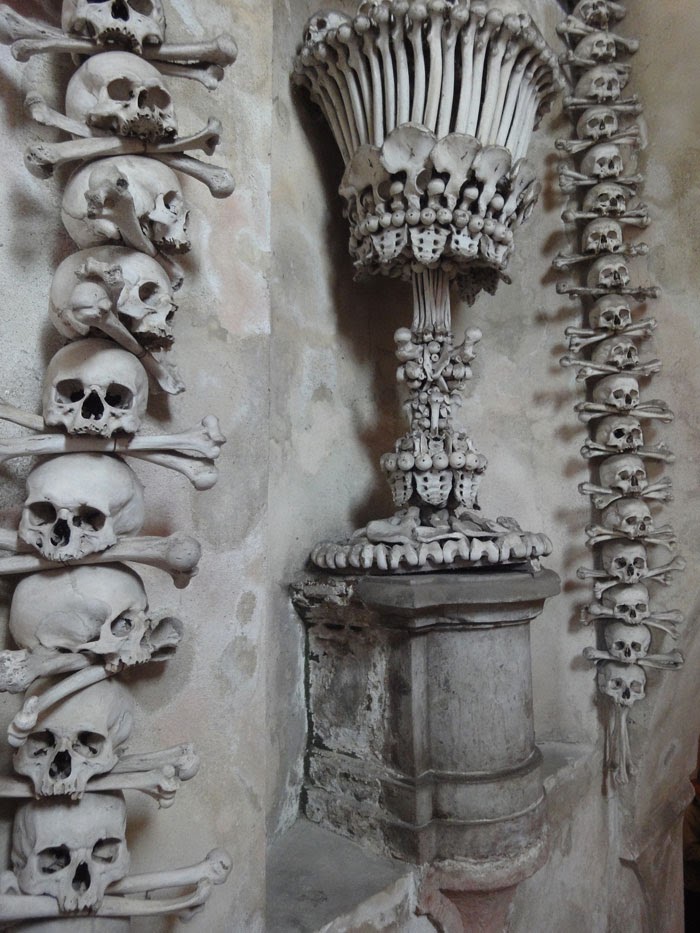

Some photos of the
sensational Sedlec Ossuary in Kutná Hora (Czech Republic). An
impressive example how death was celebrated in the Baroque.
 MosaTrajectum is a Golf Resort with villas and apartments near the Spanish city of Murcia. The whole village is walled in by some pseudo ruins. It looks like the architect took his inspirations mainly from Jurassic Park.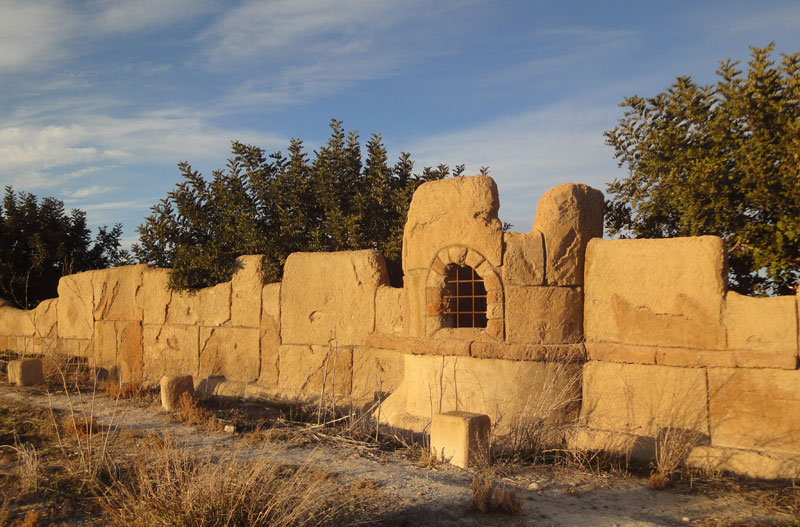


 Chelsea Market in Manhattan. A shopping mall and fruit market in Manhattan constructed 2006 in an old factory. There are a lot of elements quoting ruin and decay.

 Recently I stumbled about this nice piece of postmodern decoration. Some doors to a public park were produced with great efforts that they look like they were half broken by rust.

 Even though the buildings are a reference to the traditional huts of the Kanak tribes living in New Caledonia, there is also a strong impression of decay. The buildings seem to fall apart, to be covered by the vegetation, becoming once again part of nature.

 The Cahill Center for Astronomy and Astrophysics in Pasadena, California was designed by the Californian firm of architects Morphosis and finished in 2009.


 What I found really interesting – besides the neglected condition – was the inclined construction, which gives the illusion that the cabins where half sunken in the sand.


 The architect Wang Shu explained, that fragments of demolished buildings from all over the region were used to construct the walls of the museum. This is part of local traditional building techniques called "wa pan", developed by local farmers to cope with frequent natural disasters.


 Despite the gigantic museum is far from being something like a ruin, the whole construction resembles the skeleton of a whale and uses therefore the old romantic connection between ruins, skeletons, death and decay. Though Calatrava’s construction is of a clean, fresh washed white death and decay are omnipresent.
 It is the so called Ponte Ruinante (the ruined bridge) part of the Palazzo Barberini in Rome and probably designed by the Italian artist and architect Gian Lorenzo Bernini (1598-1680). The currently derelict bridge was already by Bernini constructed as a ruin with one of the vault stones looking as it was coming down. Bernini tried to imitate the ancient Roman ruins. As far as I know the Ponte Ruinante is maybe the first artificial ruin, the first folly ruin.


 This architects claimed that they draw their inspirations from the villages of the Anasazi Indians. But I recognize only the Roman Colosseum. Even better as the original this quotation of a ruin is covered with plants.
 But Hitler and his favorite architect Albert Speer went much further. They envisioned their buildings as ruins even before they were built. The buildings were intended to serve as monuments of the greatness of Nazi Germany. It’s clear that this didn’t refer to the Germans but only to the Nazi leaders. Hitler and Speer saw themselves as the new Pharaohs or the Roman Emperors. The people, the praised "Volk" had only to build the monuments, so that they later could stare at them with open mouth.
 To achieve these effects Speer developed the so called "Theory of Ruin Value". In his memoirs he wrote that he wanted "to build structures which even in a state of decay after hundreds or thousands of years would more or less resemble Roman models. To illustrate my idea I had a romantic drawing prepared. It showed what the reviewing stand of the Zeppelin Field would look like after generations of neglect, overgrown with ivy, its columns fallen, the walls crumbling here and there, but the outlines still clearly recognizable."
 With that drawing he convinced Hitler, who was exited while many of the other Nazi leaders were scandalized because of that obvious necrophilia.
 When Hitler’s dreams had transformed Germany into a landscape of ruins, he said that the Germans deserve to vanish because "those who remain alive after the battles are over are in any case inferior persons, since the best have fallen."


 One of the best examples is the MahaNakhon tower, which shall be build in Bangkok. The project is headed by Ole Scheeren, one of the leading architects of the Office for Metropolitan Architecture (OMA) and also the lead architect on Beijing’s CCTV headquarters.


